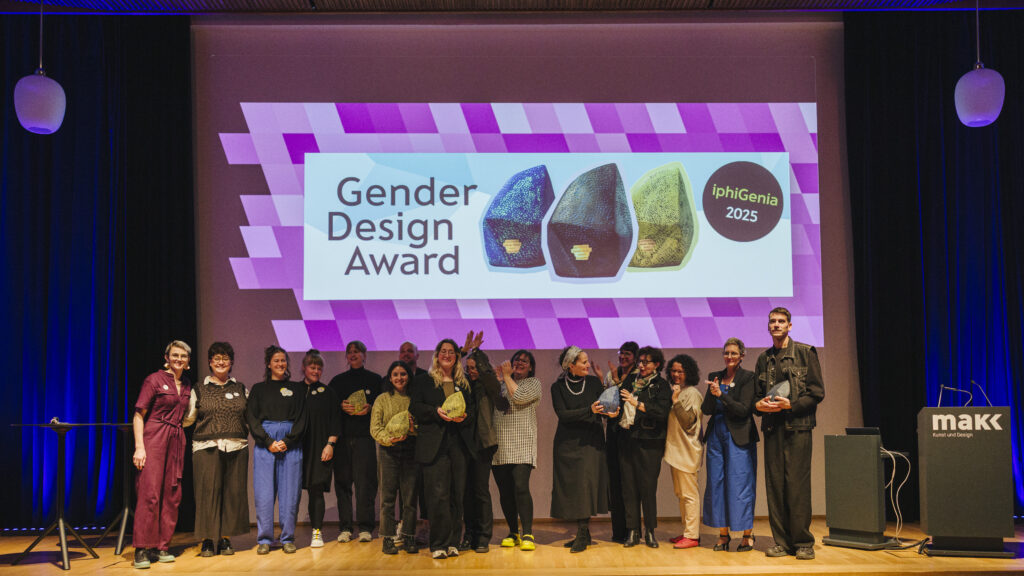
When people talk about design, it is often about form and function. Yet it is becoming increasingly clear: design has long been a political practice. The 2025 iphiGenia Gender Design Award, which will be presented for the sixth time on 4th November in Cologne, impressively demonstrates how designers see themselves as societal actors – as creators of social processes, power relations, and cultural narratives. Two major trends emerge from the award-winning works, which extend far beyond the design context: the re-politicisation of design as a means of societal reflection – and the deconstruction of historical and cultural power structures.
Trend 1: Design as Intervention – Design Becomes a Social Practice
Be it a feminist exhibition, a toolbox, or team sports: it is striking how consistently the winners understand design as a means of social dialogue. Design is no longer conceived as merely an aesthetic discipline but as an intervention in everyday social life.
With their exhibition SIND GLEICH DA, Jana C. Rowenski and Magdalena Jo Umkehrer challenge the widespread foregone conclusion of western societies that equality has already been achieved. Their “feminist intervention design” transforms abstract data and social stereotypes into sensory experiences: visitors see, hear, and feel how persistently roles and care work are still coded by gender. Equality, as presented here, becomes a tangible experience, it is a process – not a goal that has been achieved.
Luisa Nickolaus takes a similarly bold approach with TOOLSFORFOOLS. Her intervention, disguised as a DIY store brochure, is aimed at men who often do not feel addressed by the topic of feminism. With irony and analytical precision, Nickolaus transforms the toolbox, a symbol of the ‘doer’, into an educational tool: a set of tools for thinking and acting that promote self-reflection, responsibility and solidarity. Feminism is understood not as a threat, but as an invitation – as repair work on rusty structures.
Finally, Gabriel Fontana uses the playing field of sport to subvert societal power dynamics. His queer team sports reverse the principle of performance, focusing instead on collaboration rather than competition. Fontana shows that inclusion can be not just a moral expectation but a social practice – one that defines movement, empathy, and community as design tools.
All of these projects share a common idea: design is not the response to an assignment but a tool for societal self-reflection. It’s about responsibility, not representation.
At a time when feminism, diversity, and equality are once again facing significant backlash, these projects mark a new attitude: design becomes an ethical practice – political, participatory, and poetic.
Trend 2: Visibility – Design as a Historical and Cultural Corrective
The second major trend of this year’s awards can be described as a cultural reclaiming of history and identity. Design becomes a medium for remembrance and a critique of colonial and patriarchal narratives.
The UN/SEEN project by the Gutenberg Design Lab at the Mainz University of Applied Sciences reveals how female designers from the period before the Bauhaus (1865–1919) were erased from design history. With meticulous archival work, the use of digital platforms and Wikipedia entries, the team led by Isabel Naegele and Petra Eisele is bringing forgotten pioneers of graphic design back into the spotlight. The project shows that historiography itself is a design process – one that determines who is considered innovative and who remains invisible.
Gabriela Parra Sánchez goes even further with Futuras Posibles. As a Colombian artist based in Germany, she uses her migration experience to define design as a decolonising practice. In graphic and typographic experiments, she challenges western design norms and creates poetic counterimages to the hierarchies of the Global North. Migration is not seen as a deficit but as productive ambiguity – as a movement between cultures, times, and identities.
Both projects share the goal of bringing forgotten or suppressed perspectives back into the discourse. They call for a new history of design – one that no longer tells of western male dominance, but of diversity, difference and shared experiences.
Design Between Ethics and Aesthetics
What unites this year’s iphiGenia award winners is the belief that design is not neutral. It shapes what we see, how we feel, and who we listen to. In times of societal polarisation and post-factual rhetoric, this insight takes on new urgency: design becomes the language of responsibility.
The award-winning works are not products but processes – they ask questions rather than provide answers. And they demand from the discipline itself what it demands from society: reflection, openness and willingness to change.
Or, to quote the exhibition SIND GLEICH DA: equality – and with it, more equality in design – is not there yet. But perhaps, with projects like these, we’ve nearly made it.
The jury of the iphiGenia Gender Design Award 2025 was impressed by the quality, diversity and societal relevance of the submitted projects.
“So many strong, intelligent submissions – the jury work was a challenge,” says Prof. Tanja Godlewsky (IU). “I was particularly impressed by the student projects: they show how relevant and important gender-sensitive design is for the next generation. This makes it all the more urgent for the curricula to finally catch up.”
Prof. Dr. Felix Kosok (GIU Berlin, WDC) also emphasises the design relevance of the topic: “I was really impressed by so many sensitive and bold submissions that made gender and identity not just the subject, but the process of design itself.”
Prof. Dr. Bianca Herlo (Weizenbaum Institute, Berlin) describes the jury’s work as “a deeply enriching experience – characterised by diligence, respect, and impressive diversity. It is clear that gender and design are now being considered in a more comprehensive and intersectional way – with remarkable depth and nuanced approaches.”
Profa. Dra. Raquel Noronha (Universidade Federal do Maranhão, Brazil) highlights the conceptual openness: “The diversity of proposals proves that gender design is not a closed concept – nor should it be. Its openness guarantees and fosters diversity, innovation and disruption.”
And designer Claudia Herling, Chair of the iGDN and Head of the Jury, emphasises the societal context: “At a time when gender equality is under pressure worldwide, it was encouraging to come together with colleagues to share, listen to and strengthen these perspectives.”